Real estate businesses create enormous volumes of information. Acquisition assumptions may live in spreadsheets, operating performance in property systems, contracts in shared folders, and investor reporting in manually assembled workbooks. Each tool can do its job, yet the business still struggles to answer a simple question quickly: what is happening across the portfolio right now, and what should we do next?
The challenge is not a lack of data. It is the absence of reliable connections between data, workflows, documents, and decisions. A unified real estate platform closes those gaps so teams spend less time locating information and more time interpreting it.
Key takeaways
- Fragmented tools create decision friction, inconsistent reporting, and limited portfolio visibility.
- A unified platform connects information without requiring every system to be replaced or every record to live in one database.
- The highest-value integrations link acquisitions, underwriting, asset performance, documents, reporting, and governance.
- Connected, well-governed data creates the foundation for automation, advanced analytics, and responsible AI.
The real cost of fragmented real estate data
Fragmentation looks like a technology issue, but its operational effect is broader. To answer one portfolio question, a team may open an underwriting model, check the property management system, locate the latest lease file, reconcile figures with accounting, and ask an asset manager for context. The analysis cannot begin until the collection work is finished.
Information search
Skilled employees spend hours moving between spreadsheets, folders, emails, and dashboards.
Competing truths
Departments use different datasets and refresh schedules, so nobody is certain which figure is current.
Delayed decisions
Manual collection and reconciliation slow acquisitions, interventions, and strategic planning.
Limited visibility
Property-level detail exists, but leadership lacks a dependable portfolio-wide operating picture.
The hidden cost of fragmented data is the distance it creates between a business question and a confident answer.
What is a unified real estate platform?
A unified real estate platform is a connected technology environment for portfolio data and workflows. It creates relationships between properties, transactions, financial models, asset performance, documents, investors, and reports instead of treating each as an isolated process.
"Unified" does not always mean rebuilding everything inside one monolithic application. A well-designed platform can coordinate existing systems through APIs, data pipelines, integration services, shared identifiers, governance rules, and a consistent data model.
The result is a single operating layer where people can trace a number to its source, understand its business context, and move from "where is the data?" to "what does the data tell us?"
Six ways a unified platform improves portfolio operations
Connect acquisition data with portfolio strategy
Acquisition teams evaluate opportunities using market data, investment criteria, financial assumptions, property information, and operating projections. Connecting that data with the existing portfolio lets decision-makers compare projected returns with actual and historical performance, assess concentration, and understand how a new asset fits the broader strategy.
Turn financial models into actionable information
Underwriting models contain revenue, expense, cash-flow, debt, return, and valuation assumptions. Their value increases when actual operating results can be compared with those assumptions continuously. The conversation changes from "what did the model predict?" to "where is performance diverging, and why?"
Create a clearer view of asset performance
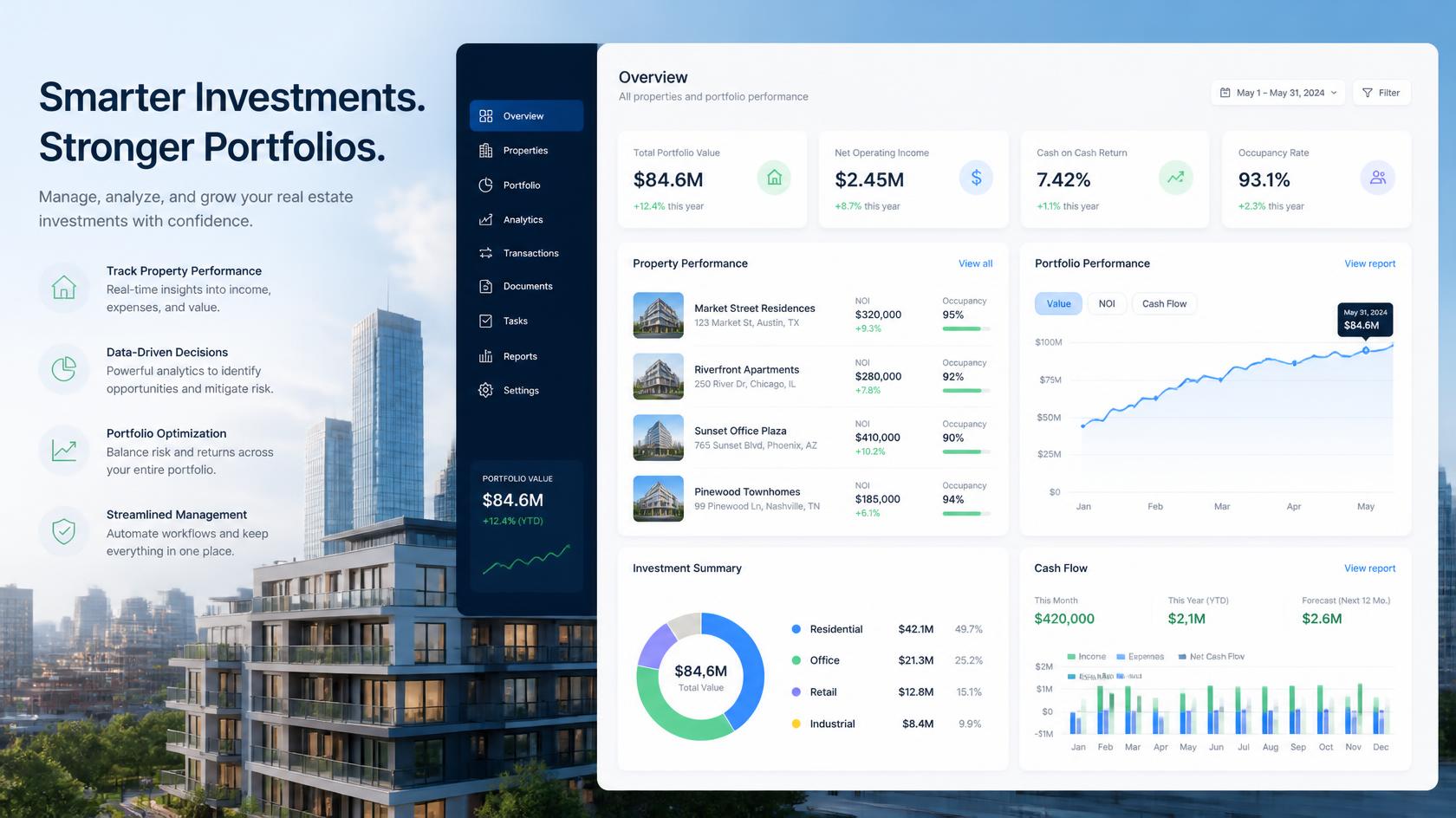
A connected view can bring together occupancy, NOI, revenue, operating expenses, leasing activity, maintenance, valuation, and budget-versus-actual results. Asset managers see both property detail and portfolio context without rebuilding the picture manually.
Bring documents into the operating workflow
Leases, contracts, property reports, legal agreements, compliance records, financial statements, and investor materials should be accessible in the context of the property or transaction they support. This reduces search time and preserves the relationship between a document and the decision it informs.
Simplify investor and management reporting
Structured data connections reduce repetitive collection across accounting, asset management, underwriting, and property teams. Reports become faster to prepare, easier to validate, and more consistent from one cycle to the next.
Establish one trusted source of truth
Teams need a governed way to access current information, understand ownership, and trace lineage. The source of truth may span several systems, but users experience it as a coordinated and trustworthy environment.
Why unified data leads to faster decisions
The value of a unified platform is not another dashboard. It is a shorter path from information to action.
Imagine a portfolio manager sees an asset fall below its NOI target. In a fragmented environment, the team must locate the latest financials, original underwriting assumptions, leasing activity, operating notes, contracts, and historical trends before diagnosing the issue. A connected platform brings those elements into the same context.
Faster does not mean careless. It means reducing low-value search and reconciliation so experienced people can spend more time evaluating risk, testing options, and acting on evidence.
The role of AI in real estate data management
AI becomes more useful when portfolio data is connected, structured, governed, and accessible. Without that foundation, promising pilots often struggle with unreliable context, inconsistent definitions, security gaps, or results that cannot be traced back to trusted sources.
A mature data foundation can support practical applications such as:
- Portfolio performance analysis and exception detection
- Automated investor and management reporting
- Lease, contract, and document intelligence
- Forecasting and scenario analysis
- Natural-language queries across approved portfolio data
- Investment opportunity screening and operational recommendations
A seven-step roadmap for a unified real estate data strategy
- 1
Map the current data landscape
Document where acquisition, financial, asset, operational, document, and investor information lives, who owns it, and how often it changes.
- 2
Identify the highest-friction workflows
Prioritize processes where teams spend the most time finding, validating, re-entering, or reconciling information.
- 3
Define a common data model
Create consistent relationships and identifiers for properties, assets, transactions, financial models, documents, entities, and investors.
- 4
Connect systems deliberately
Use APIs, event flows, middleware, or data pipelines where appropriate. Avoid duplicating information unless the operating requirement justifies it.
- 5
Design around decisions
Build dashboards and workflows around the actions people need to take rather than simply displaying every field that is available.
- 6
Automate repetitive work
Streamline recurring reporting, alerts, document processing, synchronization, validation, and routine analysis with clear exception handling.
- 7
Prepare for analytics and AI
Add governance, access controls, data quality monitoring, lineage, observability, and human review before scaling advanced use cases.
How to measure whether the platform is working
A modernization program should improve observable business operations, not only produce new screens. Establish a baseline and track a focused set of metrics:
Common pitfalls to avoid
- Starting with a dashboard: visualizing inconsistent data makes the inconsistency easier to see, not easier to solve.
- Attempting a big-bang replacement: phased integration usually reduces operational risk and creates value sooner.
- Ignoring ownership: every critical data element needs a responsible source, definition, update process, and quality expectation.
- Replicating every legacy workflow: modernization is an opportunity to remove unnecessary handoffs and duplicate work.
- Adding AI before governance: automation amplifies the strengths and weaknesses of the underlying data environment.
The future of real estate operations is connected
Growing portfolios do not need more isolated tools. They need systems that work together. As data becomes increasingly important to acquisition, asset management, reporting, and investor communication, the ability to connect information across the organization becomes a durable advantage.
Centralization is not the final objective. The objective is to help people make better decisions with trusted information.
Turn fragmented portfolio data into a decision-ready platform
We design connected real estate platforms around your properties, workflows, systems, governance requirements, and growth plans.
Unified real estate platform FAQs
What is a unified real estate platform?
It is a connected technology environment for portfolio information and workflows such as acquisitions, underwriting, asset performance, documents, investors, and reporting.
Why is fragmented real estate data a problem?
Fragmentation creates duplicate records, manual reconciliation, inconsistent definitions, slow reporting, limited portfolio visibility, and longer decision cycles.
Can a unified platform integrate with our existing systems?
Yes. APIs, data pipelines, middleware, and event-based integrations can connect approved systems, allowing modernization to happen progressively rather than through an immediate full replacement.
Can AI be used with real estate portfolio data?
Yes. Governed, connected data can support forecasting, reporting automation, document intelligence, anomaly detection, portfolio analysis, and natural-language queries with appropriate controls.
Is a unified platform only useful for large real estate firms?
No. The architecture can be shaped around the portfolio size, current systems, highest-friction workflows, security needs, budget, and anticipated growth of the organization.