
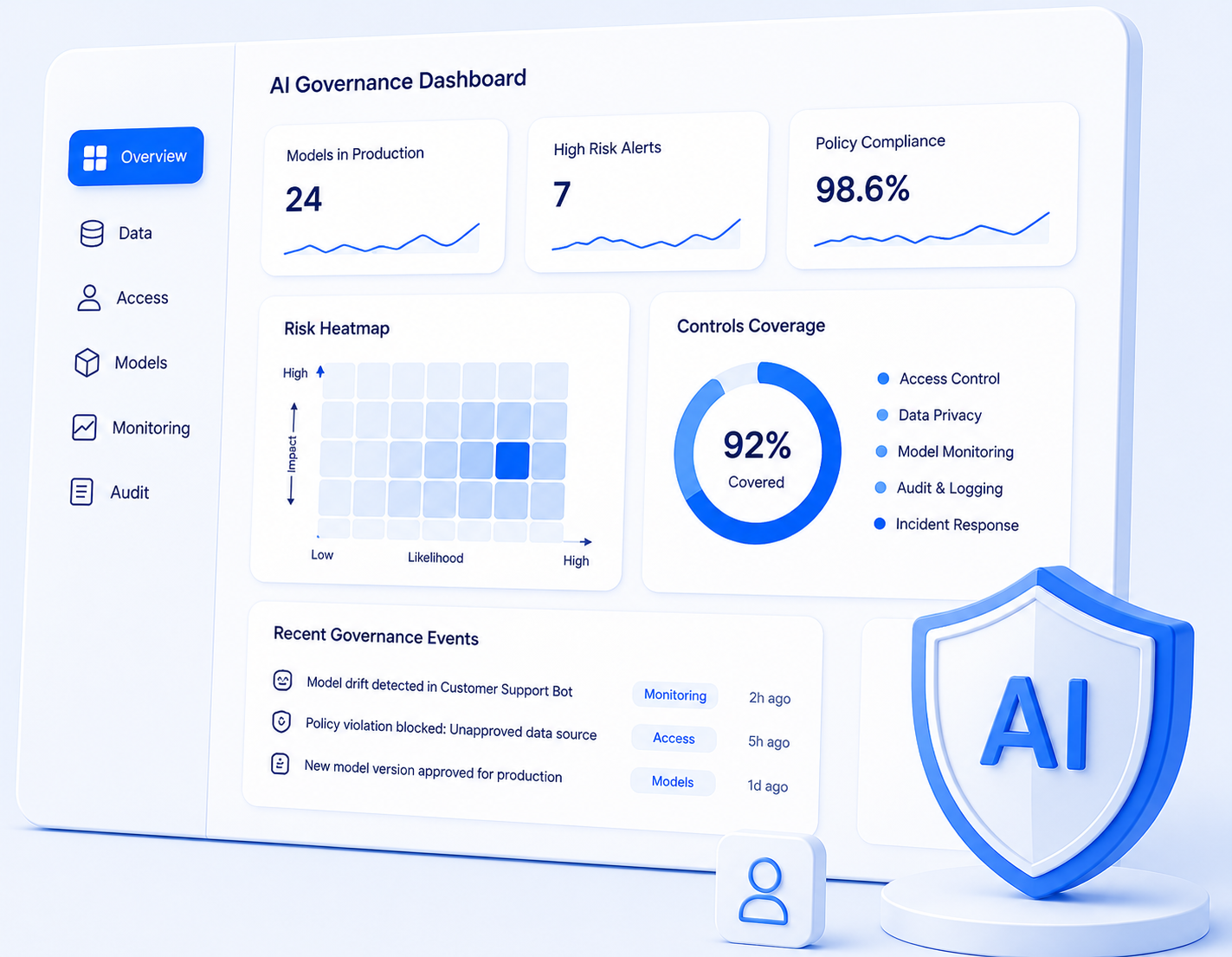
A model can perform brilliantly in a controlled pilot and still fail in production. Once AI influences customer interactions, employee decisions, financial activity, or operational actions, accuracy is only one part of readiness. The enterprise must also know who owns the outcome, what data the system can use, when a person must intervene, and how the business will recover when something goes wrong.
Enterprise AI governance turns those questions into a repeatable operating system. It connects policy with technical controls, assigns decision rights, produces audit-ready evidence, and keeps safeguards active after launch. Done well, governance does not trap AI in review. It gives capable teams a safer, faster path from experiment to dependable production.
Key takeaways
- AI governance is an operating model—not a policy document or one-time approval.
- Business owners remain accountable for outcomes while specialists own the controls within their expertise.
- Controls should be proportional to risk, impact, autonomy, data sensitivity, and reversibility.
- Monitoring, human escalation, fallback, incident response, and retirement are production requirements.
What enterprise AI governance actually means
Enterprise AI governance is the combination of policies, accountable owners, technical safeguards, evidence, and decision rights used to develop, approve, operate, change, and retire AI systems. It covers the complete application—not only the model—including data pipelines, prompts, retrieval sources, tools, integrations, user interfaces, and human workflows.
Accountability
Every use case has a named business owner, technical owner, control owners, and escalation path.
Proportional control
Higher-impact, less reversible, or more autonomous decisions receive stronger safeguards and review.
Traceability
Teams can reconstruct the approved data, model, prompt, configuration, output, reviewer, and action.
Operational resilience
Monitoring, fallback modes, rollback, incident response, and retirement protect real workflows.
Governance is effective when a team can explain what the AI is allowed to do, prove that the controls are working, and respond before a failure becomes a business incident.
Why promising AI pilots fail in production
Pilots usually optimize for feasibility: can the system perform the task? Production asks harder questions. Will it remain reliable with changing data and unpredictable users? Can it protect sensitive information? Are decisions reviewable? Can the business stop or reverse an unsafe action?
Common failures begin with unclear ownership, uncontrolled data, incomplete evaluations, broad permissions, weak human oversight, invisible drift, or no safe fallback. A team may monitor latency and uptime while missing declining answer quality, uneven performance across user groups, or business outcomes moving in the wrong direction.
The transition to production therefore requires more than another test set. It requires a governance pathway that makes risk visible, assigns authority, sets acceptance thresholds, and keeps evidence current as the system changes.
Eight controls every production-ready AI system needs
Use-case inventory and accountable owner
Register the purpose, users, affected stakeholders, business process, model or vendor, data sources, integrations, and intended decisions. Assign one business owner who is accountable for the outcome—not simply the technology.
Risk classification and approval thresholds
Classify each use case by potential impact, autonomy, data sensitivity, user reach, reversibility, and regulatory exposure. The risk tier should determine required evidence, approvers, review frequency, and release gates.
Approved data, privacy, and lineage
Define which data can be collected, used, retained, shared, and retrieved. Record provenance, consent or lawful basis where applicable, quality expectations, transformations, and deletion rules so outputs can be traced to authorized sources.
System evaluation and acceptance criteria
Evaluate the end-to-end system against representative scenarios, edge cases, prohibited behavior, security attacks, and business outcomes. Set measurable pass thresholds before testing so release decisions are evidence-led.
Identity, access, and environment separation
Apply least-privilege access to models, data, prompts, tools, logs, and administrative actions. Separate development and production, protect secrets, approve service identities, and record material changes.
Human oversight and decision rights
Specify what the AI may recommend, what it may execute, and what requires human approval. Give reviewers enough context, time, authority, and a clear way to override, escalate, or stop the workflow.
Continuous monitoring and audit evidence
Monitor quality, drift, safety events, access, latency, cost, overrides, and business impact. Preserve the versions, inputs, outputs, actions, and approvals needed to investigate an event without logging unnecessary sensitive data.
Incident response, fallback, and retirement
Define alert owners, severity levels, containment steps, rollback, user communication, recovery targets, and post-incident review. Maintain a safe manual or deterministic fallback and retire obsolete systems deliberately.
Govern the AI lifecycle—not just the launch
Governance should travel with the system from idea to retirement. Each stage has a clear decision, evidence requirement, and owner. That makes review predictable and prevents a late compliance scramble after the technical work is complete.
- Intake: confirm the business purpose, owner, affected users, alternatives, and initial risk tier.
- Design: define allowed data, user notices, human checkpoints, architecture, threats, and success metrics.
- Build: secure environments, version artifacts, constrain permissions, and make evidence collection automatic.
- Validate: test quality, safety, privacy, security, resilience, and outcome thresholds with representative cases.
- Approve: resolve exceptions, record residual risk, verify operational readiness, and authorize a defined release scope.
- Operate and retire: monitor change, review incidents, revalidate material updates, and remove access and data when the system ends.
A material change—such as a new model, prompt, retrieval source, vendor, user population, action permission, or decision context—should trigger targeted reassessment rather than silently inheriting the old approval.
Additional controls for generative AI and AI agents
Generative systems introduce risks that conventional model metrics do not fully describe. Inputs can manipulate instructions, retrieved material can be wrong or malicious, outputs can sound confident without support, and an agent with tools can turn a bad answer into a real action.
- Separate system instructions from untrusted user and retrieved content; test prompt-injection resistance.
- Measure groundedness, citation quality, retrieval relevance, refusal behavior, and unsupported claims.
- Prevent secrets, personal data, and restricted records from entering prompts, logs, or vendor training flows.
- Give tools narrow permissions, validate arguments, require confirmation for consequential actions, and limit transaction size or frequency.
- Apply output validation, content rules, deterministic checks, and human review according to the decision risk.
- Track model, prompt, knowledge-base, tool, and vendor changes; regression-test each material update.
- Red-team realistic misuse, data-exfiltration, harmful-content, and workflow-abuse scenarios before release and periodically afterward.
A seven-step enterprise AI governance roadmap
- 1
Inventory AI systems and use cases
Include internally built models, embedded vendor AI, generative assistants, automation, pilots, and shadow use. Record where each system affects people, money, access, content, or operations.
- 2
Define a practical risk taxonomy
Use a small number of understandable tiers based on impact, autonomy, data sensitivity, reach, reversibility, and obligation. Map each tier to a specific control baseline.
- 3
Assign ownership and decision rights
Name the business, product, engineering, data, security, risk, legal, and operational roles. Make it explicit who can approve, reject, pause, override, and retire a system.
- 4
Establish the minimum control baseline
Standardize required documentation, approved data, access, evaluation, user transparency, human oversight, monitoring, fallback, and incident response by risk tier.
- 5
Build evidence into delivery workflows
Connect repositories, test results, approvals, model and prompt versions, change records, dashboards, and exceptions so evidence is current and reviewable without manual chasing.
- 6
Operationalize monitoring and response
Set thresholds, alerts, owners, escalation routes, containment procedures, rollback, and communication plans. Rehearse high-impact scenarios before the system needs them.
- 7
Review outcomes and improve controls
Use incidents, overrides, user feedback, control failures, model changes, and business metrics to update the risk assessment and strengthen the control library.
Metrics that show AI governance is working
Counting policies or committee meetings does not prove control. Measure coverage, control performance, response capability, and business outcomes. Establish baselines and review trends by risk tier:
Common AI governance mistakes to avoid
- Reviewing only at launch: data, behavior, vendors, threats, and business context change after approval.
- Using one control set for every use case: low-risk assistance and high-impact automated decisions should not face identical gates.
- Producing documents disconnected from the system: evidence must reference real versions, tests, owners, controls, and production telemetry.
- Leaving the business owner out: engineering can own the system, but only the business can accept outcome and workflow risk.
- Monitoring only uptime: a responsive system can still be inaccurate, unsafe, unfair, costly, or operationally harmful.
- Failing without a safe mode: every consequential AI workflow needs a tested way to pause, degrade gracefully, or return control to people.
- Ignoring vendor changes: third-party model, retention, policy, region, and feature changes can materially alter the approved risk.
Build governance that helps enterprise AI move safely
The strongest governance programs do more than prevent failure. They give teams a shared language, reusable controls, predictable approvals, and clear operating boundaries. That reduces uncertainty and lets the organization scale the patterns that have already earned trust.
The goal is not risk elimination. It is informed, accountable risk-taking: the ability to understand the system, constrain it appropriately, detect change, protect people, and recover with confidence.
Move enterprise AI from promising pilot to controlled production
We design AI systems, governance workflows, evaluation pipelines, human checkpoints, and monitoring around your risk profile and business outcomes.
Enterprise AI governance FAQs
What is enterprise AI governance?
Enterprise AI governance is the operating system of policies, ownership, technical controls, evidence, and decision rights used to develop, deploy, monitor, change, and retire AI responsibly.
What controls does a production AI system need?
Core controls include use-case ownership, risk classification, approved data, access management, system evaluation, human oversight, continuous monitoring, audit evidence, fallback procedures, and incident response.
Who should own AI governance?
Governance should be cross-functional. The business owner remains accountable for outcomes, while product, technology, data, security, legal, risk, and operations teams own the controls within their expertise.
How often should production AI systems be reviewed?
Review frequency should match risk and change. High-impact systems need continuous monitoring and regular formal review, plus reassessment after material model, data, prompt, tool, vendor, workflow, or policy changes.
Does AI governance slow product delivery?
Poorly designed governance can. A risk-tiered program with reusable controls, early ownership, automated evidence, and clear approval criteria reduces rework and makes responsible releases more predictable.
How should third-party AI vendors be governed?
Assess the complete service, including data use and retention, security, model and policy changes, regional processing, availability, monitoring, subcontractors, exit options, and how the vendor supports incidents and evidence requests.